
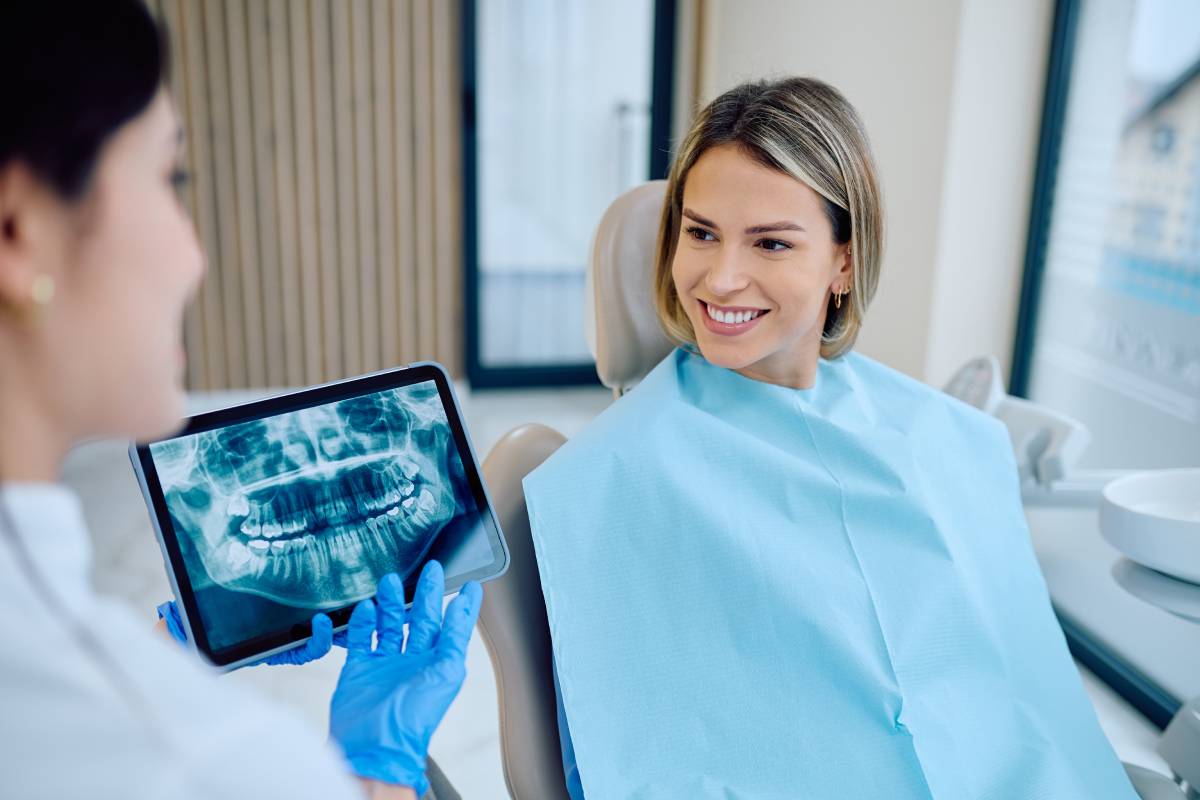
Dental X-rays and digital scans are routinely used in every dental office. But what is the difference between digital dental scans and traditional X-rays? In this article, we discuss these two methods, their advantages and disadvantages, and their uses in dentistry.
The Difference Between Digital Dental Scans and Traditional X-Rays
Traditional X-rays and digital scans are used to monitor oral health conditions, diagnose potential issues, and plan treatments. X-rays and scans help your doctor identify the issues that are not visible during a regular exam. Both methods can be employed for:
- Cavity and tooth decay detection
- Evaluating tooth roots and surrounding bone tissue
- Identifying infections and abscesses
- Detecting impacted teeth (teeth hidden underneath the gum)
- Monitoring gum disease and jawbone loss
- Planning restorative treatments (crowns, bridges, implants)
- Orthodontic planning
- Surgeries planning
Let us look at the main differences between the two methods in more detail:
Traditional Dental X-rays
Dental X-rays use a small amount of radiation to capture 2D images of teeth and surrounding bone. Common types of dental X-rays include bitewings, periapical X-rays, and panoramic X-rays.
In most dental offices, X-rays are a common part of oral exams. Typically, this method provides sufficient derealization for routine exams and treatment planning.
Digital Dental Scans
Digital dental scans typically use 3D imaging or optical scanning technologies, such as Intraoral scanners (for digital impressions of teeth and gums) and 3D cone-beam imaging (for detailed views of bone, nerves, and tooth roots).
Digital scans produce more detailed images than traditional X-rays. They allow for accurate depth perception—the ability to see how far structures are from one another in three-dimensional space. As a result, your doctor can determine how close a tooth root is to a nerve, how much bone is available for an implant, or the exact position of impacted teeth.
Additionally, digital scans allow your dentist to enlarge and rotate the image to examine the tissue from several points. Rotating and viewing images from different angles enables more accurate diagnoses.
Digital scans are often used to diagnose more complex issues and plan complex procedures. They are typically more expensive than traditional X-rays.
Are Digital Scans Better than X-rays
Digital scans can provide images of superior quality compared to traditional X-rays. However, X-rays are still perfectly sufficient for routine checkups, detecting cavities, evaluating root health, and monitoring bone loss from gum disease.
Digital scans can be preferred when planning for dental implants and orthodontic treatments, detecting complex jaw or nerve issues, and evaluating wisdom teeth.
How Often Should I Have a Digital Dental Scan or an X-ray
How often you should have a digital dental scan or an X-ray depends on your oral health, age, and risk factors. Typically, patients with good oral health are recommended to have X-rays or scans every 12 to 24 months. Patients with higher oral health risks or existing issues may be advised to have a scan or X-ray every 6 to 12 months.
Are Dental X-rays and Scans Harmful?
For most patients, both traditional dental X-rays and digital scans are considered safe with no risk of side effects or health complications. Even though X-rays and 3D digital scans use radiation, the dose does not exceed the amount of radiation you are exposed to during a short airplane flight or a day of natural background radiation.
Sign Up for a Dental Exam at My Dentist Upland
Whether you have oral health concerns or require a routine exam, do not hesitate to make an appointment with an experienced dentist at My Dentist Upland. At our dental office, we offer modern diagnostic and treatment methods to help preserve and improve each client’s oral health.